
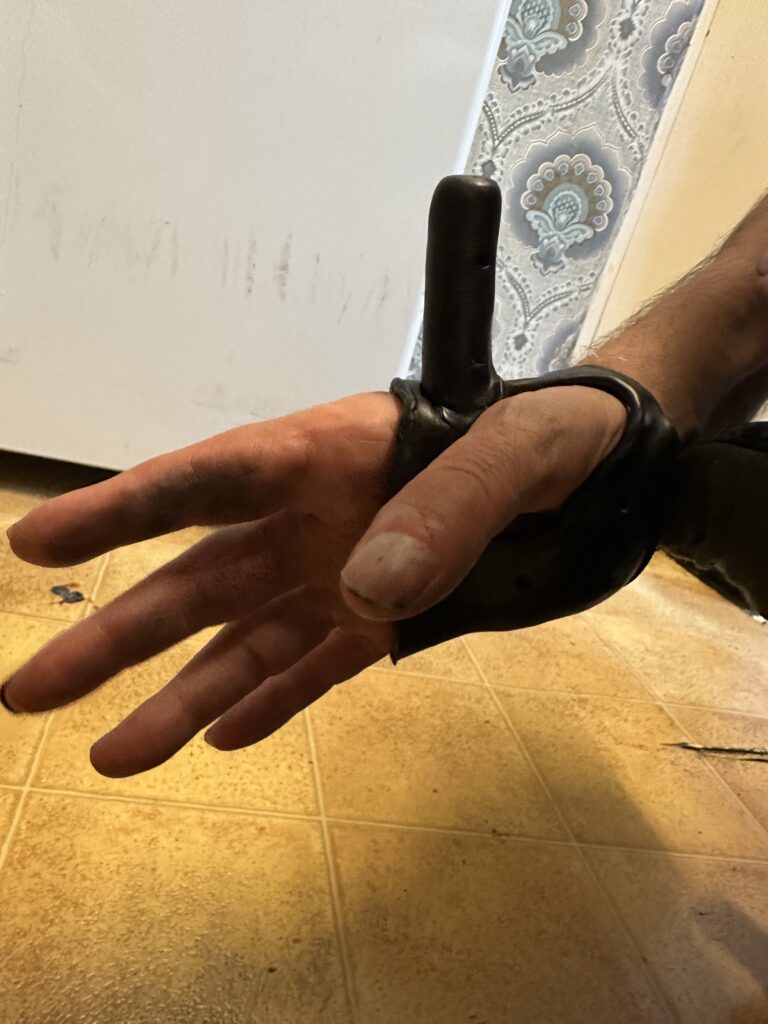
Struggling with bowel management after a spinal cord injury? There may be a better way.
For many people living with quadriplegia or high spinal cord injuries, bowel care is one of the most time-consuming, frustrating, and dependent aspects of daily life.
Digital rectal stimulation (DRS) is a well-established technique used to help trigger bowel emptying.
However, in practice, we often see a gap between what is commonly used and what is actually accessible for people with limited hand function.
At After Hours Physio & Hand Therapy, we provide home-based assessment and custom solutions to help improve independence, efficiency, and dignity in bowel care.
What is Digital Rectal Stimulation (DRS)?
Digital rectal stimulation is a technique used in people with neurogenic bowel, particularly those with upper motor neurone (reflex) bowel, which is common in cervical spinal cord injuries.
The goal is to:
- Trigger the recto-colic reflex
- Relax the anal sphincter
- Initiate reflex bowel emptying
Traditionally, this is performed using a gloved, lubricated finger, applying gentle circular stimulation inside the rectum.
It is a core component of bowel programs in spinal rehabilitation.
Why is bowel care so difficult for people with quadriplegia?
Many people with C5–C7 injuries experience:
- Reduced hand dexterity
- Weak grip strength
- Limited fine motor control
This makes even simple tasks difficult, including:
- Handling suppositories
- Using mini-enemas
- Performing manual digital stimulation
As a result:
- Many patients become fully dependent on carers
- Bowel routines can take 45–90 minutes or more
- There is often a loss of privacy and independence
Current bowel management options (and their limitations)
1. Suppositories
- Require fine motor control
- Difficult to open and insert
- Often require assistance
2. Mini-enemas
- Require grip strength and coordination
- Hard to control pressure and positioning
3. Transanal irrigation (TAI)
- Can be effective
- But involves:
- Multiple steps
- Equipment setup
- Training
👉 While TAI can be a game changer for some, it is not suitable or preferred by everyone.
The missing gap: assistive solutions for digital rectal stimulation
Despite DRS being widely used:
- It is still performed manually in most cases
- There are very few purpose-built assistive devices
This creates a clear gap for people who:
- Want more independence
- Have limited hand function
- Struggle with traditional techniques
What is a custom digital rectal stimulation solution?
A custom DRS solution typically involves:
- A modified or adaptive splint/device
- Designed to:
- Compensate for reduced hand function
- Allow controlled, safe stimulation
- Reduce reliance on fine motor skills
It may include:
- Built-up handles
- Stabilised positioning
- Ergonomic design tailored to the individual
👉 The goal is not just to “replace the finger”
👉 But to restore function and independence
Who may benefit from a custom DRS device?
This approach may be suitable for:
- Quadriplegic / tetraplegic patients
- Individuals with:
- Poor hand dexterity
- Weak grip strength
- Fatigue with bowel care
Especially if:
- Bowel routines are long (>45–60 minutes)
- There is heavy carer dependence
- Current methods are ineffective or inconsistent
How is digital rectal stimulation performed safely?
Digital rectal stimulation involves:
- Gentle insertion of a lubricated finger or device
- Slow circular motion to stimulate reflex bowel activity
- Repeating stimulation every few minutes until evacuation occurs
⚠️ Safety is critical, particularly in high spinal cord injuries.
Autonomic Dysreflexia (AD)
Patients with injuries above T6 may experience:
- Sudden headache
- Sweating or flushing
- Rise in blood pressure
👉 If this occurs:
- Stop immediately
- Sit upright
- Seek urgent medical attention if severe
Our approach: home-based, personalised care
At After Hours Physio & Hand Therapy, we bring this service directly to you.
What we do:
- Comprehensive bowel management assessment
- Review of:
- Current routine
- Timing and efficiency
- Equipment used
- Assessment of hand function and dexterity
- Design and trial of custom assistive solutions
Why home visits matter:
- We assess you in your real environment
- Optimise:
- Positioning
- Equipment setup
- Workflow
👉 This leads to more practical, sustainable improvements
What outcomes are we aiming for?
Our goal is simple:
✔ Reduce time spent on bowel care
✔ Improve consistency and predictability
✔ Increase independence
✔ Reduce caregiver burden
✔ Improve dignity and quality of life
Is this service right for you?
If you or someone you care for:
- Has a spinal cord injury
- Is struggling with bowel management
- Feels overly dependent on others
👉 This may be a valuable option to explore.
Book a home assessment
We offer home-based physiotherapy and hand therapy services across Melbourne, including after-hours support where needed.
👉 click here to book an appointment
Or call 0415 238 432 to discuss your situation.